 JUST MERCY


Cholera in the Mountains! – Bill’s report
There was a definite chill in the air as the wind drove the rain through the cracks in the building where we were losing the battle for the young boy’s life. I was grateful we had brought a Coleman lantern because the night was pitch black. The dark clouds completely obscured any light that might come from heaven and electric lights were a world away. It was June 1, 2011.
Yvrose had taken a particular liking to this young boy. He was twelve years old with a sweetness of spirit that drew her heart to him. Bazelais was his name and he had contracted a deadly bacterial disease causing such severe diarrhea and vomiting that its victims die of dehydration in a few hours to a few days: CHOLERA!
Earlier, we had started him on an I.V. to replace the water and minerals he was losing so rapidly and it looked like he was going to be ok. But some how he had pulled the catheter out of his arm and now in the dark cold wet night by the light of a lantern we worked to reinsert a needle into his now collapsing veins. His cries in the night caused us to fight back the tears as we tried again and again probing with the needle knowing if we didn’t succeed their was little hope.
So we prayed and we worked and he cried until finally we knew all there was left to do was pray. His eyes rolled back in his head and I feared the worst. Had we in our blundering efforts done more harm than good? What was I doing here in this remote mountain region of Haiti?
Days earlier, we had received news of a cholera outbreak in Pensek. The people came to us, a small company of believers under the banner of JUST MERCY, because they knew we would not ask, “Can we do a thing?” but “Should we do a thing?” and let our feet follow our heart. They knew we had made previous trips to remote areas to bring cholera prevention, education, treatment, and supplies.
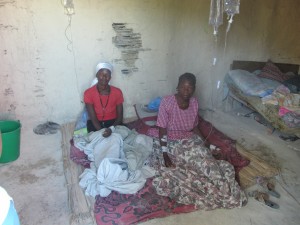
Patients at Grand Rac
A few weeks ago there was a cholera outbreak in a village called Grand-Rak, six hours upfrom the trailhead. We heard stories of people dying on the way down to the Cholera Treatment Center in Fonds-Parisien because of the difficulty and distance of the trip. We went to Grand-Rak where we established a treatment center where their disease could be managed.
Our first trip was mostly reconnaissance with stretchers and supplies. When we saw the need, we went back down and organized a medical team from PAP to spend a few days. Three times in the next week we arranged for medical personnel to go up but they could only stay 1-2 days each time.
I came back down and we hired two Haitian nurses and sent them to the CTC next door to receive training. The cholera had died down in Grand-Rak by then so we put the nurses on standby till the next outbreak that we knew would come.
After two trips that week, six hours up and six hours down, a total of 24 hours of hiking difficult mountain terrain, I tried to imagine what it would be like having to come down that trail while sick with such a disease as cholera. It seems a miracle that anyone makes it.
The people came to us because they knew that we would go to remote areas of the mountains. The people told us that Pensek was centrally located, a mere two hour hike from many of the mountain places we had been including Marozeau and Pays-Pourri. If the people had to come down to the CTC in Fonds from Marozeau and Pays-Pourri for treatment, it was a 4 – 6 hour hike and they had to come down riverbeds, contaminating the water source with their waste. The path through Pensek is the only route from many of the surrounding villages to the CTC’s down the mountain so it seemed this would be a good place to establish a cholera outpost clinic.
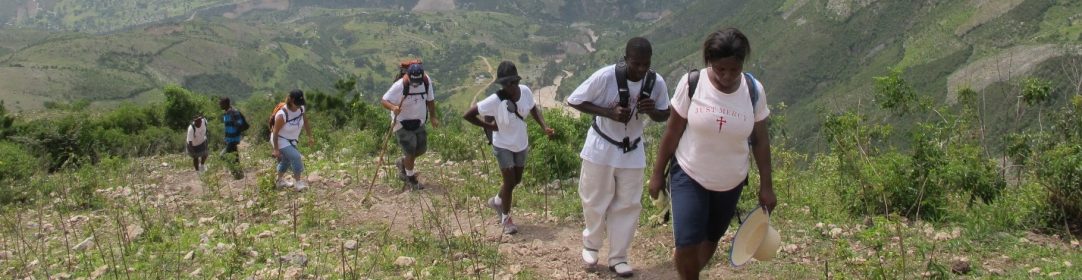
We were given a UNICEF tent from the IFM Cholera Treatment Center so we hauled the heavy 20 x 40 foot tent four hours up the mountain on mules and men. Young women carried cholera treatment supplies up the very steep and rugged trail on their heads. Though the journey was difficult, it was filled with the wonder and beauty of God’s creation. At the end of it when we arrived late that afternoon, there were three cholera victims waiting for us, Bazelais being one of them.
We set up a makeshift shelter inside an unfinished concrete building to help block the wind, rain, and chill of the night. We began the treatment of the patients, administering Oral Rehydration Solution, starting I.V.’s. and giving doxycycline, an antibiotic used to treat cholera.
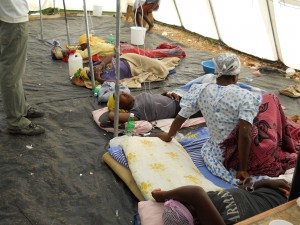
Cholera patients on the plastic on the floor
Should I take a few minutes to describe the unsanitary conditions dealing with a diseasewhere people lose all their body fluids? Where there is no electricity and you work with a couple of small flashlights for light? Where the nearest water source is an hour away or rainwater has to be caught as it drips off the roofs? Where the floors are dirt and you have to try to prevent the human waste carrying the cholera bacteria from spreading to the whole village? Where the difficulty of even just washing your hands is problematic? The conditions were a nightmare!
And what of Bazelais? When we realized that our efforts to insert a catheter into a vein was futile, I emphasized the necessity of continuing to give him oral hydration but knew he was beyond our power to help. All we could do was pray and try to get him to drink the fluids he so desperately needed while he threw them up as quickly as we poured them down him. I continued to pace back and forth and pray.
I finally gave up the vigil and went back to lie down on my mat on the floor in the wet and sweat and filth and cover up with a blanket that I had brought from home. As I began to get warm under the blanket, I thought of Bazelais lying on the dirt floor covered with only a sheet, shivering with the cold. So I got up and took the boy my blanket. We covered him up and Yvrose said, “Bill, something happened a minute ago! The light came back in his eyes and he looked at me and smiled and I know he’s going to be okay!”
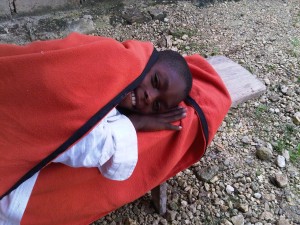
Bazelais in the morning!
The next morning he was still alive and still smiling. Did I say the dark clouds completely obscured any light that might come from heaven? No, for surely the Great Physician made a visit that night and so I told Bazelais and his mother that he should change his name to Emmanuel because God was certainly with him!
The nurses have treated 40 cases since that day. There were seven more today, June 12, 2011. So far, by God’s grace, all have been saved. The victims continue to come and JUST MERCY continues to try to find transportation to gather up donated supplies, sometimes having to go to PAP to do so, find transportation to the trailhead, which is not easy, and do all the other things that are necessary to keep the supply line going.
The problem is bigger than we can deal with without more resources. We need to create a dependable supply line to support the clinic. Mules are hard to find when we need them. Sometimes we can only get one when we need ten. We believe we need to purchase ten mules and all the gear we need to continue to make the trips delivering medical personnel and all the necessary supplies to support this desperately needed life saving “clinic”.
Right now we have no vehicle to pick up supplies and personnel in PAP and elsewhere and deliver them to the trailhead where only 4-wheel drive trucks can go. So far, Victory Compassion has helped with this each time but their resources have become more limited recently as someone threw a rock through their windshield and another truck got a rock through its oil pan driving through the rising water going to Mal Pass. We have to get a vehicle.
So what are we doing in these remote mountain regions of Haiti? Putting one foot in front of the other as we let our feet follow our heart, doing as much as we can, as quickly as we can, for as long as we can, for young boys like Bazelais and his mother, for the least of these our brothers, and as we blunder along this path, when we are weary and hot and seemingly at the end of our resources, the Good Shepherd picks us up, lays us across his shoulders, and we discover a strength and peace and purpose “up there”, and we know what we are doing in Haiti……wishing we could love Him more!!!
Post Script:
June 12th – 40 patients treated in the last 11 days
June 13th – Contact could not be established with the clinic.
June 14th – The clinic has treated 75 people total. Currently they have 30 people in the clinic, too many for the nurses to care for and not enough supplies. The urgency increases.
June 15th – The clinic is full. We asked Yvrose how many people. She said the nurses have stopped counting. Victims are coming night and day. The nurses are in tears from exhaustion and overwhelmed by the situation. There have been two deaths.
Bill and I are scrambling to contact people for help to buy mules, pay for more nurses, and for funds for vehicles to transport supplies and people. We are looking for a ticket for Bill to return to Haiti in the next few days. We don’t understand why this battle for life and death has fallen to our little “fellowship” in Haiti but it has. We’ve looked and continue to look for better prepared and equipped people willing to take up this cause. So far, JUST MERCY is the only answer the people of this mountain region have been given.
Today, Yvrose, our Haitian sister who has taken in 22 children since the quake and runs a school for poor children, who we help support, is headed up to Pensek along with Manolo and Juani, a wonderful couple from the Canary Islands sharing our lot in Haiti. They were able to catch a ride with a UN truck to take the supplies to the trailhead and begin the arduous journey up. We fear what they will find.
Yesterday someone pledged $3500 for five mules to help with the supply line. A Springfield Ladies Bible Class took up a collection and got enough for a mule. Our biggest need is for funds to hire more medical people and for vehicles. The need is immediate and huge. This is not just another fund raising letter. People are dying and we can do something about it.
We need help as soon as possible. Our website now has a paypal donate button on both the WELCOME and How We Can Help page. Our e-mail address is info@justmercy.org. We appreciate anything you can do.